A smarter supplement shelf.
Before you add another capsule, get clear on the purpose, the evidence, and the product behind the promise.
Read the story ↗Look past the midlife marketing to understand where creatine research is useful—and where the promises run ahead.
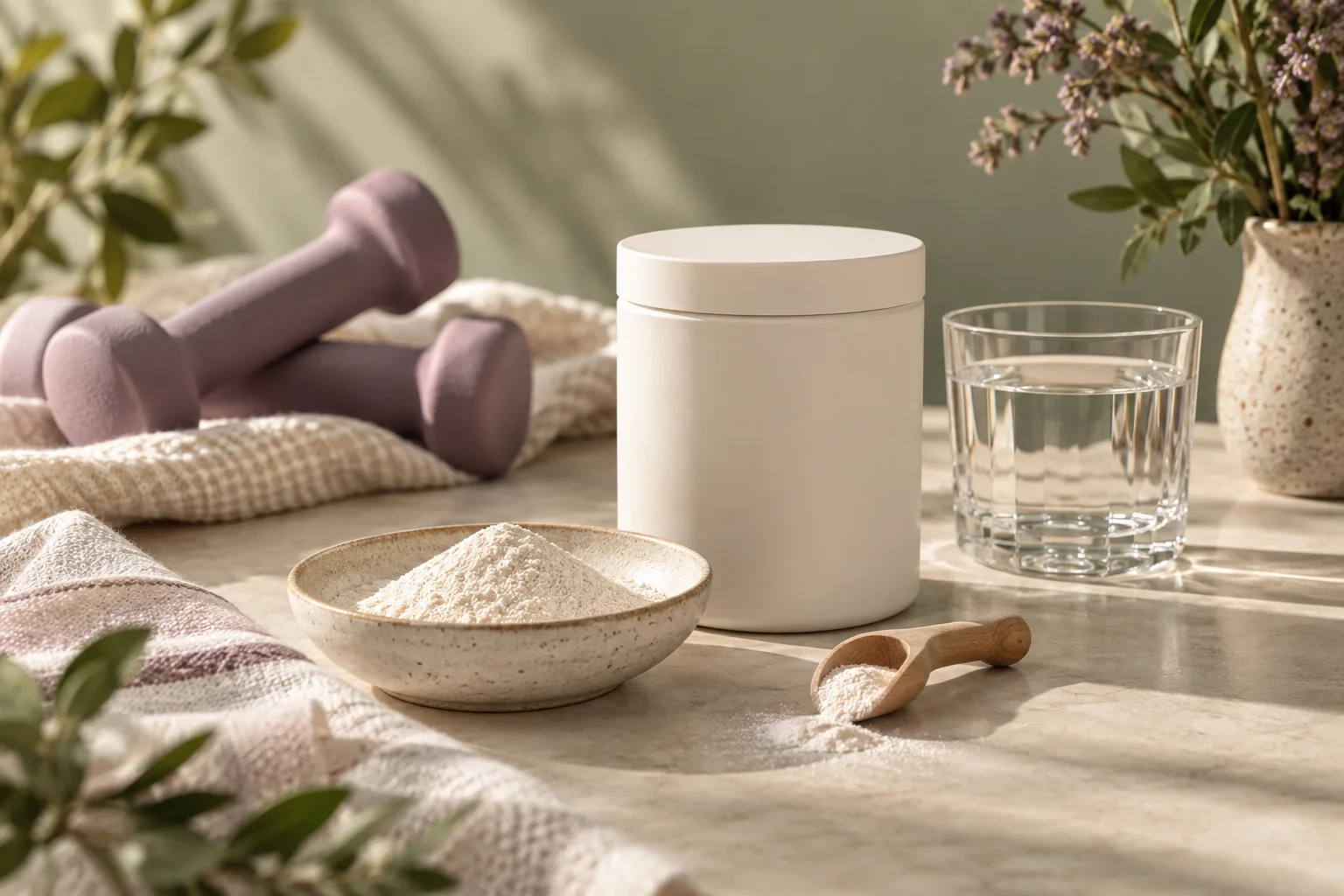
Creatine has moved from the weight room into the beauty and longevity conversation. That makes it worth understanding, especially when a product is presented as a must-have for every woman in midlife. A useful question is more specific: what activity or outcome is this supplement supposed to support?
NIH's Office of Dietary Supplements explains that creatine helps supply energy for short, intense efforts. Evidence is strongest for repeated bursts of activity such as weight lifting and sprinting. Responses vary, and the benefits do not extend equally to endurance activities. A general promise of more energy all day is a different claim.
A two-year randomized trial enrolled 237 postmenopausal women in exercise programs, comparing creatine with placebo. It found no added benefit for bone mineral density at the measured sites or for the tested strength outcomes. Some bone-geometry measures and walking performance improved; a completer subgroup showed an increase in lean tissue mass.
Those mixed findings are more informative than a headline claiming creatine protects every woman's bones. Bone geometry is not the same outcome as fewer fractures, and a result in postmenopausal participants does not answer every question about perimenopause. This trial did not establish longer life, treatment of menopause symptoms, or a universal need for supplementation.
Creatine monohydrate is the most studied form, according to NIH ODS. More expensive forms have not demonstrated clear superiority. A product marketed specifically to women may offer a flavor or format you like, but the branding alone is not evidence of a special biological advantage.
Check the complete ingredient list and amount per serving. Compare the actual creatine content, not just the number of scoops or gummies in the package. Ask whether you want the extra ingredients in a blend and whether they duplicate another product you already use. Convenience is valuable when you understand what you are buying.
NIH ODS describes generally reassuring safety evidence in healthy adults, while noting water-related weight gain and possible gastrointestinal discomfort. That evidence is not a personal clearance for someone with a medical condition. Discuss your medicines, supplements, relevant health history, and goals with a qualified clinician or dietitian; this article does not supply a dosing plan.
Independent certification can help answer product-quality questions. NSF describes testing for label accuracy and contaminants; its Certified for Sport program also screens for prohibited substances. Verify the exact product in the certifier's directory. Certification does not demonstrate that the supplement produces every advertised benefit or that it is appropriate for you.
Before purchasing, decide what useful progress would look like and who can help you interpret it. A supplement should have a defined role within your routine, with room to review whether it earns its cost.
Connect the purchase to a specific training goal.
Look for relevant participants, outcomes, and limitations.
Review ingredients, certification, cost, and personal suitability.
Creatine has useful exercise evidence. A menopause or longevity label still needs evidence for its own claims.
This is general education, not a diagnosis or a personal treatment plan. Discuss medical treatments, supplements and changes relevant to your health with a qualified clinician. Research and regulatory guidance can change. How we work.
Before you add another capsule, get clear on the purpose, the evidence, and the product behind the promise.
Read the story ↗
Think beyond the mirror. Build the capacity for stairs, travel, play, and everyday independence.
Read the story ↗An inviting approach to nourishment: colorful meals, satisfying protein, and a routine that fits real life.
Read the story ↗